The Fragmentation Tax: What Scattered Supplier Relationships Are Really Costing Your Business
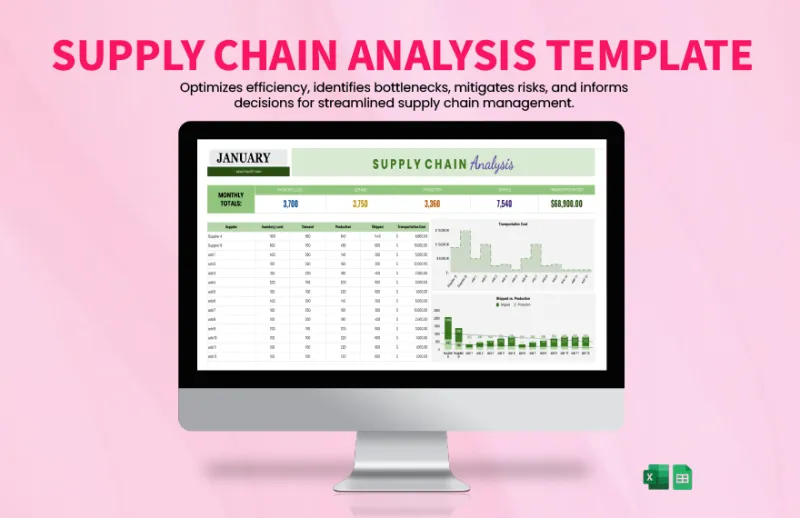
Photo: business supply chain management cost analysis spreadsheet office, via images.template.net
For many independent retailers and mid-market merchants across the United States, supplier diversity feels like a risk management strategy. Spread your sourcing across fifteen, twenty, even thirty vendors and you insulate yourself from any single point of failure — or so the logic goes. But beneath that apparent resilience, a quieter problem is compounding month after month: the fragmentation tax.
This isn't a line item on your income statement. It's a diffuse, structural drain on your margins that accumulates across logistics, compliance administration, accounts payable workflows, and inventory coordination. When you finally add it up, the number tends to surprise even experienced operators.
What Fragmentation Actually Looks Like in Practice
Fragmentation in sourcing isn't simply having multiple suppliers. Most healthy businesses work with several vendors across different product categories. The problem emerges when those relationships multiply without a unifying system — when each supplier operates on different payment terms, ships from different regions, uses different labeling formats, and requires separate onboarding documentation.
Consider a regional home goods retailer managing 22 active suppliers. Each vendor relationship demands its own purchase order process, its own lead time management, and its own compliance verification cycle. Procurement staff spend an estimated 30 to 40 percent of their time on administrative coordination rather than strategic sourcing decisions. That's not a staffing problem. That's an architecture problem.
The operational overhead compounds further when inbound shipments arrive on misaligned schedules. Warehouse receiving staff process smaller, more frequent deliveries from a wider range of carriers. Freight costs per unit climb because consolidated shipping discounts evaporate when order volumes are spread thin. A single supplier receiving a $40,000 purchase order will negotiate freight terms that a fragmented model — distributing that same $40,000 across eight vendors — simply cannot access.
Calculating Your Fragmentation Tax
To understand what fragmentation is costing your operation, it helps to break the analysis into four buckets.
Logistics and freight premiums. Pull your freight invoices from the past 12 months and calculate your average cost per unit shipped. Then compare that figure against the published rate cards for consolidated LTL or full truckload shipments from your highest-volume suppliers. The gap between what you're paying and what you could pay under a consolidated model is the starting point for your fragmentation tax calculation.
Administrative labor. Estimate how many hours per week your purchasing, accounts payable, and receiving teams spend managing supplier-specific processes — resolving invoice discrepancies, chasing compliance documents, updating vendor records. At the average fully-loaded cost of a US operations employee (approximately $28 to $35 per hour depending on market), even five hours per week per supplier relationship across a fragmented portfolio can represent six figures in annual overhead.
Inventory carrying costs. Fragmented sourcing often forces merchants to carry higher safety stock levels because lead time variability is harder to predict when you're managing dozens of independent supplier timelines. The cost of holding that excess inventory — typically estimated at 20 to 30 percent of inventory value annually when you account for storage, insurance, obsolescence, and capital tied up — represents another hidden drag on margins.
Compliance and onboarding burden. Supplier compliance requirements — product certifications, insurance documentation, labeling standards, EDI capability — all require ongoing verification. When those requirements differ across a fragmented supplier base, the compliance overhead multiplies proportionally. For retailers selling in regulated categories like food, personal care, or children's products, this cost can be substantial.
When merchants work through this exercise honestly, a fragmentation tax in the range of 4 to 9 percent of gross merchandise value is not unusual. For a retailer doing $3 million in annual purchases, that's $120,000 to $270,000 in recoverable cost.
The Concentration Risk Counterargument — And Why It's Often Overstated
The standard objection to supplier consolidation is concentration risk. Reduce your supplier count and you increase your exposure to any single vendor's disruptions — production delays, financial instability, capacity constraints. This concern is legitimate, but it is frequently used to justify a level of fragmentation that goes well beyond prudent diversification.
There is a meaningful difference between strategic diversification — maintaining two or three qualified suppliers per critical category — and the kind of unmanaged sprawl that accumulates when supplier relationships are added reactively rather than by design. Most merchants who audit their supplier portfolios discover that 60 to 70 percent of their purchase volume flows through fewer than 30 percent of their vendors. The remaining suppliers often represent marginal categories, opportunistic one-time purchases, or legacy relationships that have never been formally evaluated.
Consolidating around a core group of vetted, high-performing suppliers — while maintaining deliberate secondary options for critical categories — preserves the genuine risk management benefit of diversification without the operational penalty of unmanaged fragmentation.
How Centralized B2B Platforms Change the Equation
One of the structural reasons fragmentation persists is that the tools to manage it have historically been expensive and complex. ERP systems capable of consolidating supplier management, inventory visibility, and compliance tracking have been the domain of large enterprises with the IT budgets to match.
Modern B2B commerce platforms are changing that dynamic for independent and mid-market merchants. By centralizing supplier discovery, order management, and compliance documentation within a single environment, these platforms allow merchants to reduce their administrative overhead without necessarily reducing their supplier count. More importantly, they provide the data infrastructure needed to make deliberate consolidation decisions — identifying which supplier relationships are genuinely adding value and which are simply adding noise.
For merchants who have never formally calculated their fragmentation tax, the exercise is revealing. The cost of doing business in a scattered, uncoordinated way is real, measurable, and — in most cases — largely avoidable. The first step is simply deciding to look at the numbers honestly.
At CommerceTop, we work with merchants and suppliers to build the kinds of structured, transparent trade relationships that make fragmentation a choice rather than a default. The businesses that thrive in competitive retail environments are increasingly the ones that treat their supplier portfolio as a strategic asset — not just a list of contacts.